
Goals with measurable results
Set goals once and track them from company to individual.
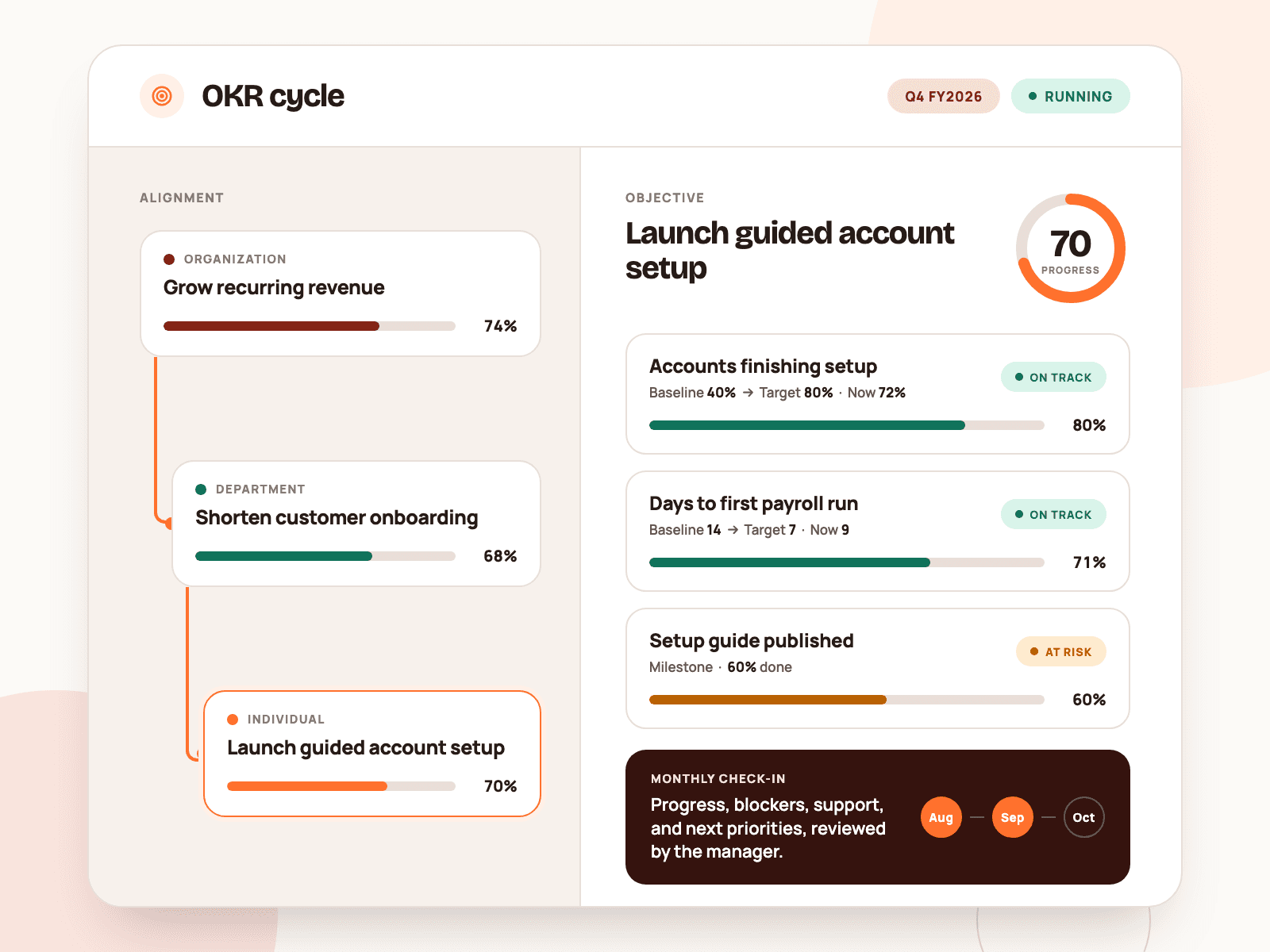
WorkMentor gives HR and managers a structured way to run OKRs. Each cycle holds objectives at the organization, department, team, and individual level, and each objective has three to five key results measured from a baseline to a target. Owners check in monthly with a status and notes, supervisors review those check-ins, and a final review closes each objective with a score. Those scores feed the combined KPI and OKR scorecards used in performance reviews.
Get startedNo credit card required
What your team can do
The workflow, with the details in place.
Quarterly, half-yearly, and annual cycles with objectives at organization, department, team, and individual level
Three to five key results per objective, measured from a baseline to a target or tracked as milestones
Employee proposals with manager approval, monthly check-ins with On track, At risk, or Off track status, and supervisor review
Final reviews, weighted scores, and a company dashboard that feed combined KPI and OKR scorecards
What changes
More control, with less reconstruction.
These connected results show how okrs and goal tracking carries useful context from the first action through the wider operating workflow.
Goals that stay aligned
Each objective can support one above it, so department, team, and individual goals trace back to company priorities.
Progress that is checked monthly
Check-ins record the current value, status, blockers, and next priorities. A key result with no check-in for 31 days is flagged overdue.
Scores that reach the review
Key results roll up into objective and cycle scores, which feed the combined KPI and OKR scorecards that HR releases.
Common questions
Questions about okrs and goal tracking.
What are OKRs in WorkMentor?
OKRs are objectives and key results for a cycle. Objectives sit at the organization, department, team, or individual level, and each has three to five key results. Progress is tracked with monthly check-ins and closed with a final review.
How often do employees check in on their OKRs?
Monthly. A check-in records the current value or percent done, a status of On track, At risk, or Off track, and short notes on progress, blockers, support needed, and next priorities. A key result is flagged overdue after 31 days without one.
Can employees set their own OKRs?
Yes, when the organization allows it. An employee proposes an objective and it needs one approval from someone above them in the reporting line, or from Admin, HR, or HR Payroll. Supervisors can also create objectives directly, and those are active immediately.
How are OKRs scored?
A key result's progress runs from its baseline to its target. An objective's progress is the average of its key results, and the OKR score is the weight-adjusted average of its objectives. Scores of 90 and above are excellent, 75 and above on track, and 60 and above need improvement.
Do OKRs feed performance reviews?
Yes. After a cycle is closed and fully scored, HR can calculate and release scorecards that combine each person's KPI and OKR results using the KPI and OKR weightage. Employees see the scorecards they have been sent.
Which plan includes OKRs?
OKRs are included in the Pro and Enterprise plans, not Free.
Connected in WorkMentor
Built to move with the rest of WorkMentor.
The same people and work records continue into these connected product areas, so each handoff keeps the context your team already created.
OKRs and goal tracking
Goals with measurable results